


For Shri Krishna Gopal Das, a tomato farmer from North Kachucherra village in Tripura’s Dhalai district, bacterial wilt had become a persistent challenge, threatening crop survival and reducing the returns from his cultivation. Despite favourable market demand for tomatoes, frequent plant mortality and inconsistent yields made it difficult to realise the crop’s full economic potential. The introduction of Swarna Anmol, a bacterial-wilt-resistant tomato hybrid assessed by Krishi Vigyan Kendra (KVK), Dhalai, during 2024–25, brought encouraging results, increasing marketable yield by 29.65% and demonstrating the potential of disease-resistant hybrids to improve farm profitability.
Tomato is an important commercial vegetable crop in Dhalai district, supported by favourable winter conditions, the availability of family labour and regular demand in local markets. However, its cultivation is often constrained by bacterial wilt, tomato leaf curl disease, early and late blight, fruit borer infestations, water stagnation and imbalanced nutrient management. Among these challenges, bacterial wilt is particularly destructive, as infected plants can wilt and die rapidly, reducing plant population and causing substantial yield losses. Repeated cultivation of susceptible varieties in the same fields can further aggravate the problem, making disease management a critical factor in successful tomato production.
Before the intervention, Shri Krishna Gopal Das cultivated the commercial hybrid NS 962. Although the variety produced comparatively large and firm fruits, bacterial wilt frequently affected plant survival under the warm and humid conditions of the region. Uneven crop establishment, disease-related losses, expenditure on plant protection and inconsistent marketable yields affected the reliability of his production. The limited availability of suitable disease-resistant hybrids further complicated the challenge, discouraging him from expanding tomato cultivation despite the crop’s income-generating potential.

Recognising these constraints, KVK Dhalai undertook an On-Farm Testing (OFT) programme on Shri Das’s farm to assess the performance of Swarna Anmol under local growing conditions. The initiative was implemented by KVK Dhalai under the technical supervision of ICAR–Agricultural Technology Application Research Institute, Zone VII, Umiam, Meghalaya, with Swarna Anmol technology developed by ICAR–Research Complex for Eastern Region (RCER), Patna, Bihar, forming the basis of the assessment. The hybrid was evaluated against NS 962 under the farmer’s prevailing cultivation practices to determine whether it could offer a more dependable and profitable alternative.
The intervention combined varietal assessment with scientific crop-management guidance. KVK scientists advised the farmer on nursery management, selection of healthy seedlings, field preparation, transplanting on raised beds, balanced nutrient application, timely staking, irrigation and proper drainage. Regular monitoring of pests and diseases, along with appropriate crop protection, harvesting and marketing practices, formed part of the recommended approach. Scientists also made field visits to assess crop establishment, plant vigour, flowering, fruit setting, disease incidence and marketable yield throughout the growing season.
The results revealed a clear advantage for Swarna Anmol in plant survival, disease management and overall productivity. The hybrid recorded 96.4% plant establishment after transplanting, compared with 88.2% for NS 962. Final plant survival reached 94.6%, against 84.8% in the farmer’s existing hybrid. Most notably, bacterial wilt incidence was limited to 1.8% in Swarna Anmol, compared with 11.6% in NS 962, representing an 84.5% reduction. The improved hybrid also recorded lower incidences of tomato leaf curl disease and early and late blight, at 2.4% and 2.8%, respectively, compared with 6.8% and 5.6% in NS 962.
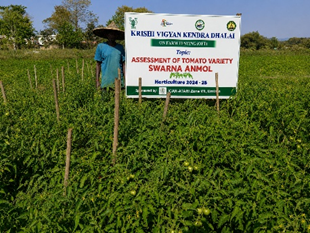
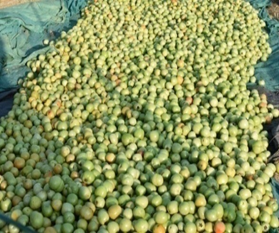
Although NS 962 produced larger individual fruits, averaging 94.6 grams compared with 68.4 grams in Swarna Anmol, the improved hybrid compensated through a greater number of fruits per plant. Swarna Anmol produced an average of 47.2 fruits per plant, compared with 30.8 in NS 962. It also recorded a higher marketable fruit percentage of 89.5%, against 82.6% in the farmer’s existing hybrid, and sustained a longer crop duration of 148 days, compared with 132 days for NS 962. Harvesting of Swarna Anmol began at 70 days, slightly later than the 65 days recorded for NS 962, but the longer productive period supported more sustained harvesting.
These advantages translated into a substantial increase in marketable production. Swarna Anmol recorded a yield of 58.60 tonnes per hectare, equivalent to 586 quintals, compared with 45.20 tonnes per hectare, or 452 quintals, from NS 962. The additional 13.40 tonnes per hectare represented a 29.65% increase in marketable yield. The findings demonstrated that, under the conditions of the assessment, better plant survival, lower disease incidence, more fruits per plant and a higher proportion of marketable produce collectively outweighed the advantage of larger individual fruits in the farmer’s existing hybrid.
The improvement in productivity also strengthened the economic returns from tomato cultivation. At an assumed sale price of ₹15 per kg, Swarna Anmol generated an estimated gross return of ₹8.79 lakh per hectare, compared with ₹6.78 lakh from NS 962. The cost of cultivation was ₹1.96 lakh per hectare for Swarna Anmol and ₹1.88 lakh for NS 962.
Despite the additional investment of ₹8,000 per hectare, the improved hybrid generated a net return of ₹6.83 lakh per hectare, compared with ₹4.90 lakh from the existing variety. This amounted to an additional net return of ₹1.93 lakh per hectare, while the benefit-cost ratio improved from 3.61:1 to 4.48:1.
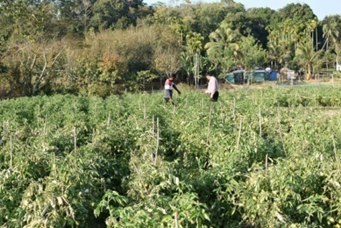
The benefits were equally meaningful at the farmer’s own field scale. Shri Das cultivated Swarna Anmol on approximately 0.16-hectare, equivalent to one kani of land. Based on the recorded marketable yields, the estimated production from this area was 9,376 kg under Swarna Anmol, compared with 7,232 kg under NS 962. At the assumed price of ₹15 per kg, the improved hybrid generated an estimated gross return of ₹1,40,640 and a net return of ₹1,09,280.
In comparison, the corresponding net return from NS 962 was ₹78,400. The difference amounted to an additional net income of approximately ₹30,880 from one kani of land, illustrating the potential economic significance of adopting a suitable disease-resistant hybrid.
For Shri Krishna Gopal Das, the experience reinforced the importance of selecting a variety suited to local production challenges. Reflecting on the results, he shared that bacterial wilt had earlier caused the death of several tomato plants and reduced his final yield. With the guidance of KVK Dhalai, he observed better plant survival, vigorous crop growth and sustained fruit harvesting after adopting Swarna Anmol. Although the fruits were smaller than those of NS 962, the higher fruit numbers and greater marketable production resulted in nearly 30% higher yield and improved net income. The encouraging outcome strengthened his confidence in the hybrid and the value of scientific crop-management practices.
The demonstration also generated interest among neighbouring farmers. The healthy crop stand, comparatively low incidence of bacterial wilt and regular harvesting attracted attention from growers who had experienced similar disease-related losses. Observing the performance of Swarna Anmol provided them with a practical opportunity to understand the benefits of disease-resistant hybrids when combined with healthy seedlings, balanced nutrition, staking, proper drainage and regular crop monitoring. Shri Das also shared his experience with tomato growers in North Kachucherra and neighbouring villages, helping extend awareness of the intervention beyond his own farm.
The successful assessment of Swarna Anmol by KVK Dhalai highlights the role of agricultural research and extension in addressing location-specific production challenges. The experience demonstrates that improved varietal selection, supported by scientific crop management and regular technical guidance, can contribute to better plant survival, lower disease losses, higher marketable yields and improved farm income. While outcomes may vary with weather, disease pressure, crop-management practices and market prices, the results from Shri Krishna Gopal Das’s farm provide an encouraging basis for further evaluation and wider adoption of suitable disease-resistant tomato hybrids in Dhalai district and other comparable areas of Tripura.
From a crop threatened by recurring disease to a more productive and economically rewarding enterprise, Shri Krishna Gopal Das’s experience illustrates how the convergence of improved technology and farmer-focused extension support can strengthen the prospects of small and marginal farmers. Swarna Anmol has emerged as a promising option under the conditions assessed, offering a pathway towards more reliable tomato production, better returns and sustainable vegetable cultivation in the region.
(Source: Krishi Vigyan Kendra, Dhalai)


Like on Facebook
Subscribe on Youtube
Follow on X X
Like on instagram