


15 October, 2026, Barrackpore, West Bengal
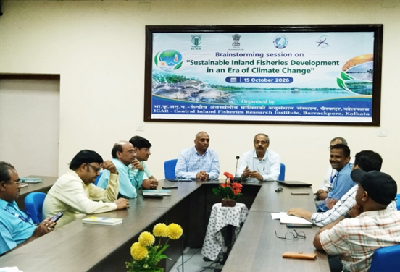
Emphasising climate-resilient fisheries, innovative technologies and sustainable utilisation of inland water resources, the ICAR-Central Inland Fisheries Research Institute, Barrackpore, organised a brainstorming session on ‘Sustainable Inland Fisheries Development in an Era of Climate Change’ to identify emerging priorities and strengthen strategies for sustainable fisheries production, biodiversity conservation and livelihood enhancement.
Dr B.K. Behera, Chief Executive, National Fisheries Development Board, inaugurated the session as the Chief Guest, while Dr Pradip Dey, Director, ICAR-CIFRI, presided over the function. Welcoming Dr Behera to the Institute, Dr Dey emphasised the importance of strengthening scientific research, technological innovation and institutional collaboration to address the emerging challenges of climate change and unlock the vast potential of inland fisheries for sustainable production and livelihood enhancement.
Addressing the gathering, Dr Behera emphasised the need for adaptive and sustainable approaches to enhance fish production and secure the livelihoods of fishing communities. He highlighted the potential of culture-based fisheries in wetlands and reservoirs and the diversification of cage culture practices as promising interventions to improve the productivity of inland water resources while ensuring their sustainable management.
Highlighting technology-driven solutions to market access challenges, Dr. Behera discussed the use of drones for transporting live fish from remote locations to markets through pre-defined routes. He advocated pan-India demonstrations of heavy-payload quadcopter drones, particularly in the northeastern region, where difficult terrain and geographical isolation often impede timely fish transportation. Wider adoption of this technology could improve market connectivity, reduce transportation delays and facilitate the efficient delivery of live fish to consumers.
Dr Behera also stressed the importance of conserving and promoting the culture of small indigenous fish species (SIFs) in wetlands. Recognising their ecological importance, he highlighted their contribution to aquatic biodiversity, nutritional security and rural livelihoods. He called for integrating the conservation and sustainable utilisation of these species into inland fisheries development strategies to achieve a balance between ecological sustainability and economic benefits for fishing communities.
Emphasising a forward-looking vision for sustainable and climate-resilient inland fisheries, Dr Pradip Dey, Director, ICAR-CIFRI, stated, “The future of inland fisheries lies in transforming scientific knowledge into scalable, climate-smart and economically viable solutions that benefit both aquatic ecosystems and fishing communities.
By unlocking the untapped potential of wetlands and reservoirs, conserving and promoting indigenous small fish species, and harnessing emerging technologies for efficient fish transportation and market integration, we can build a more productive, resilient and sustainable fisheries sector. Stronger institutional partnerships, particularly with NFDB, will be pivotal in accelerating the translation of research innovations into field-level impact, enhancing nutritional security, generating sustainable livelihoods and contributing to the vision of a prosperous and self-reliant fisheries sector in the country.”
The brainstorming session brought together the Heads of Divisions and scientists to deliberate on emerging research priorities, climate-related challenges and opportunities for transforming inland fisheries into more resilient and sustainable production systems. The discussions highlighted the importance of aligning institutional research with practical technological solutions, responsible resource utilisation, aquatic biodiversity conservation and improved market access.
The meeting was attended by the Heads of Divisions along with other scientists and research scholars of ICAR-CIFRI. Dr Dey expressed appreciation for NFDB’s continued support to the Institute and acknowledged the Board’s contribution towards strengthening inland fisheries development and improving the welfare of fishing communities.
The deliberations reaffirmed the importance of integrating climate resilience, technological innovation, biodiversity conservation and institutional collaboration to unlock the potential of inland fisheries. The emphasis on productive wetlands and reservoirs, indigenous fish species and drone-enabled transportation underscored the need for practical, scalable solutions that can strengthen fisheries sustainability, nutritional security and livelihood opportunities across the country.
(Source: ICAR-Central Inland Fisheries Research Institute, Barrackpore)


Like on Facebook
Subscribe on Youtube
Follow on X X
Like on instagram