


Onion is one of the most important commercial vegetable crops in India and an essential component of the Indian diet. India is among the world's leading onion-producing countries, and the crop plays a significant role in farmers' livelihoods, agricultural trade, food supply and consumer price stability.
According to the Agricultural Statistics at a Glance (2025), onion cultivation in India covered approximately 1.98 million hectares’ area during 2024–25, with a total production of about 30.80 million tonnes. Over the past five decades, onion cultivation in India has shown a strong increasing trend, with area expanding from about 0.12 million hectares in the 1960s to over 1.9 million hectares and production rising more than tenfold due to improved varieties, irrigation, and better agronomic practices, although recent fluctuations have been observed due to climatic variability and market factors.
Despite this substantial production, ensuring a continuous supply of good-quality onions throughout the year remains a major national challenge because of seasonal harvesting, inadequate storage infrastructure, post-harvest losses and fluctuations in market prices. A major challenge in onion storage arises from the seasonal concentration of production, particularly the rabi crop, which accounts for approximately 60% of total onion production and is generally harvested between April-May. The stored rabi onions are crucial for meeting market demand during the subsequent monsoon and lean-production periods, often extending until October–November.
However, onions are susceptible to physiological weight loss, sprouting, rotting and microbial deterioration during prolonged storage. High temperature, elevated relative humidity, inadequate ventilation, mechanical injuries and improper curing accelerate these losses, especially during the monsoon season. Under conventional ventilated storage conditions, total losses can exceed 50% in certain reported trials. The consequences of inadequate onion storage extend beyond physical losses and directly affect farmers' income, consumer affordability and national market stability.
Therefore, the development and adoption of affordable, efficient and scientifically designed onion storage technologies a national priority. Conventional naturally ventilated storage structures widely used because of their relatively low initial cost; however, their performance may be inadequate under adverse temperature and humidity conditions, leads to storage losses in the tune of 30-50%.
Improved storage solutions, including naturally ventilated structures with optimized airflow, modular and multi-tier storage systems, and appropriately designed temperature- and humidity-managed facilities, can help reduce storage losses up to 25%. Reducing onion storage losses is therefore essential not only for improving farmers' profitability but also for stabilizing prices, ensuring year-round availability and strengthening India's agricultural supply chain.
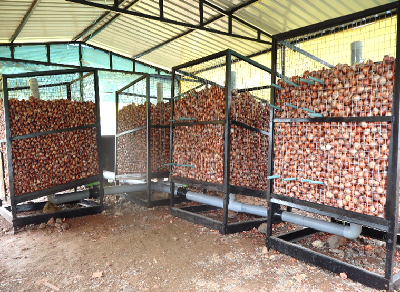
To address these issues a multi-module onion storage system has been designed, developed and evaluated. The system consists of multiple modules each of 1 tonne storage capacity. The individual module was connected to the aeration blower unit through the network of PVC pipes. The forced air then passed through the vertical perforated pipe fitted at the central position of the rectangular storage module. The equal distribution of the air flow was adjusted through the flow controlling ball valves fitted before the entrance of air in to the vertical pipe. Slight angle was provided to the bottom perforated plywood sheet of each module for easy discharge of the onions.
The whole system was installed under shed having overall dimension of 7.92 m × 6.10 m × 2.44 m (length × width × height) for a 9-tonne storage capacity. The developed system was easily foldable and flexible for installation, easy for transportation and can be arranged in multiple units as per the required capacity. The arrangement of the storage modules can be done in staggered branching manner as well as in linear series manner based on the availability of space and multiple blower units.
The open sides of the shade have been provided with flexible polythene sheet rolled over hanging pipe-based covering can also be used for protection of the storage lot from rain. While evaluating on 5 tonnes of storage capacity, the system reduces the total storage losses up to 14.07% during peak monsoon season for the period of 6 months. Among the total losses weight loss observed to be 11.12% while sprouting and rotting was 0.59% and 2.36 %, respectively as compared to 51.76% of total losses includes 22.15% weight loss, 7.65% of sprouting and 21.96% of rotting under control condition. Overall, the developed system reduces 72.81% of total losses over control.
The quality attributes of the onion observed to be significantly retained during the storage period. The cost of 9 tonne storage capacity system was Rs. 1.5 Lakhs. A farmers storing an onion lot with initial market price of Rs. 10/kg and sale it after a 6 months of storage period with a market value of Rs. 40/kg, this system further provides a net benefit of Rs. 20,320/tonne from the developed system to the farmer.
Considering the low cost of onion storage system this is very much affordable to the small and marginal farmers. The system provides a valuable buffer period to the onion growing farmers as well as entrepreneurs allowing them to optimize their marketing strategies and reduce distress sales at lower prices to maximize the profit. This system can also serve as a means of a circular economy.
Overall, the developed system is boon for the farmers, entrepreneurs and MSME’s.
(Source: ICAR - Central Institute of Agricultural Engineering, Bhopal)


फेसबुक पर लाइक करें
यूट्यूब पर सदस्यता लें
X पर फॉलो करना X
इंस्टाग्राम पर लाइक करें