

ICAR Research Complex for NEH Umiam has launched innovative podcast initiatives in vernacular languages to empower hill farmers of all the seven sister states with tailored agricultural knowledge. These podcasts aim to improve adoption of best practices and enhance farm productivity through accessible, need based and context-specific information.
A playlist has been created covering various subjects and topics such as piggery, poultry, fishery, horticulture, natural resource management, organic agriculture practices, other livestock and animals, and plant protection. This organized playlist facilitates easy access for viewers to select and watch podcasts according to their own interests. Likewise, the playlist has also been created according to the five language/dialect viz. Hindi, English, Khasi, Manipuri and Nagamese.
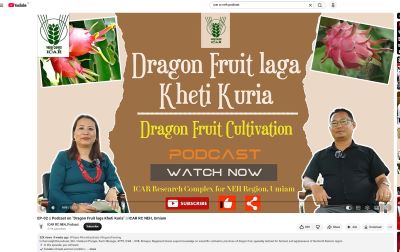
Dr G. Kadirvel, Director, ICAR RC-NEH has stated that the recording and uploading in other six to seven regional dialect/language of Mizoram, Assam/Bengali, Garo, Sikkim and Arunachal Pradesh are under process to cater the need of all farmers of the region.
Further, the Head of the Division of Technology Assessment and Capacity Building at the institute, reiterated that, in addition to video talks through podcasts, small educational videos will also be developed in all regional languages and dialects in the future to educate various stakeholders of the region. A separate playlist of the ‘Farmers Talk’ has also been created to make the information dissemination much strong since the farmers information is highly credible for the fellow farmers.
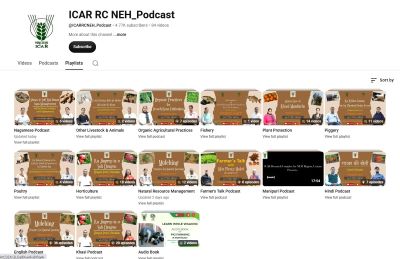
He mentioned that the total number of viewers on the podcast channel has reached to 2.1 lakhs, and added that initially, podcasts were recorded only in English because most educated farmers understand English. However, once a podcast was recorded in the local dialect (Khasi) of the farmers and received the highest viewership, it was prioritized to record future podcasts in local dialects as well.
(Source: ICAR Research Complex for NEH Umiam, Meghalaya)


फेसबुक पर लाइक करें
यूट्यूब पर सदस्यता लें
X पर फॉलो करना X
इंस्टाग्राम पर लाइक करें