

For generations, fish farming in the hill ecosystems of Churachandpur district, Manipur, remained largely a subsistence activity. Tribal farmers relied on traditional backyard ponds, often without scientific water management, balanced stocking or regular fish-health practices.
Highly acidic soil and water, with pond pH ranging from 5.2 to 5.8, constrained biological productivity, while the use of undersized fry and indiscriminate stocking further limited returns. With little or no regular liming, plankton monitoring or health prophylaxis, farmers often had to wait 12–14 months for harvests, yet annual production remained modest at about 800–1,050 kg/ha, with fingerling survival generally below 35–40%.
Breaking this cycle required more than simply introducing a new technology—it required building farmers’ knowledge, confidence and capacity to manage their ponds scientifically.
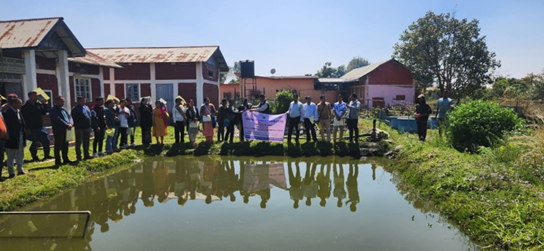
Recognising this opportunity, ICAR-KVK Churachandpur, ICAR-Research Complex for NEH Region, Manipur Centre and ICAR-Central Institute of Fisheries Education, Mumbai, under the Tribal Sub-Plan (TSP), in collaboration with ICAR-ATARI Zone VII, Umiam, implemented an intensive capacity-building and participatory technology demonstration programme. Led by Dr. S. Munilkumar, Nodal Officer, TSP, ICAR-CIFE; Dr. Manoj Kumar Pandey, Senior Scientist-cum-Head, KVK Churachandpur; and coordinated on the ground by Dr. N. Soranganba, SMS/CTO (Fisheries), KVK Churachandpur, the initiative combined hands-on training, water diagnostics, farm exposure and the delivery of critical production inputs.
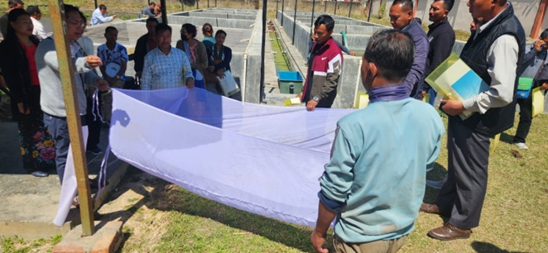
The intervention brought together 76 progressive fish farmers—34 men and 42 women—from 32 tribal villages across Churachandpur district and adjoining watersheds. The approach was deliberately participatory, enabling farmers to move beyond receiving technical advice to understanding, testing and applying scientific practices directly in their own ponds. Training sessions on fish-based Integrated Farming Systems introduced farm-waste recycling, including the use of poultry and pig droppings to enhance plankton production, vegetable cultivation on pond dykes and bio-silt harvesting. Subsequent modules focused on sustainable freshwater aquaculture, including scientific liming, advanced fingerling acclimatization and prophylactic fish-health measures. Farmer-participatory research further strengthened on-farm trial monitoring, feed conversion ratio tracking, growth assessment and disease surveillance.
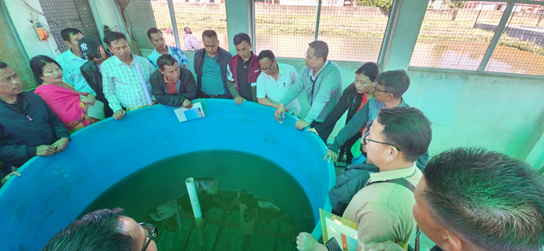
The transformation became visible in the ponds themselves. Soil and water management brought pond pH up from the highly acidic 5.2–5.8 range to a more suitable 7.2–7.6. Instead of relying on random stocking of small fry, farmers adopted advanced fingerlings of 8–10 cm and scientifically determined stocking densities and species combinations. Stocking density was optimized to 7,500–8,000 fingerlings per hectare, following a 30:30:40 ratio for surface-, column- and bottom-feeding carps. As a result, fingerling survival rose sharply from 35–40% to 78–82%.
The gains extended beyond survival. Average harvest weight after ten months increased from 250–350 g to 650–950 g per fish, while total annual harvest rose from around 850–1,050 kg/ha to 2,650–3,100 kg/ha—an increase of about 200–215%. Improved feeding practices also reduced feed wastage by approximately 50%, with the Feed Conversion Ratio improving from 2.8–3.2:1 under traditional practices to 1.4–1.6:1 under the scientific system.
For farmers, however, the most meaningful transformation was measured not only in kilograms of fish, but in household income.
Under the traditional system, production of approximately 950 kg of fish per hectare generated about ₹1.90 lakh in gross fish revenue at an average farmgate price of ₹200/kg. After accounting for operational expenses of around ₹1.40 lakh, the resulting net farm income was about ₹50,000/ha/year, with a Benefit–Cost Ratio (BCR) of 1.35.
The scientific integrated farming model changed this economic equation dramatically. Fish production increased to approximately 2,850 kg/ha, while better-sized table fish fetched an average farmgate price of ₹240/kg, generating ₹6.84 lakh from fish sales alone. The transformation did not stop at the pond. Seasonal crops such as cabbage, king chilli and papaya cultivated along pond dykes generated an additional ₹95,000/ha, taking gross economic realization to ₹7.79 lakh/ha. Even with higher operational expenditure of around ₹3.14 lakh/ha for quality fingerlings, liming, pelleted feed and disease management, farmers achieved a net farm income of ₹4.65 lakh/ha/year. The BCR correspondingly increased from 1.35 to 2.48.
What began as a pond-level intervention soon started creating ripples across the participating villages.
A farmer-centred cycle of diagnosis, intervention, monitoring and feedback became the foundation of the programme. Farmers learned to assess soil and water quality, apply lime as required, acclimatize fingerlings, optimize stocking, manage feeding, recycle farm waste, monitor fish health and improve harvesting and market linkages. Peer learning and field-level feedback further helped farmers refine practices according to their local pond conditions.
One of the most significant outcomes was the emergence of localized nursery enterprises. In the Lamdan and New Canaan belt, farmers moved away from dependence on fragile fry transported from lowland hatcheries and began establishing small nursery units in upstream water pockets. Six localized fingerling-rearing micro-enterprises emerged, collectively supplying more than 1.20 lakh acclimatized fingerlings within the sub-division. This also reduced seed mortality during transportation from about 60% to below 8%, strengthening local seed availability and reducing dependence on distant sources.
The initiative also opened new avenues for women’s participation in aquaculture. Of the 76 participating farmers, 42 were women. In Kokadan Daron, Kokadan Khullen and Majuron Kabui, participating women formed joint pond-management groups and introduced structured feeding and staggered harvesting practices. These efforts generated an additional disposable cash flow of approximately ₹6,500–₹9,200 per family per month, helping households meet children’s educational expenses while improving food security.
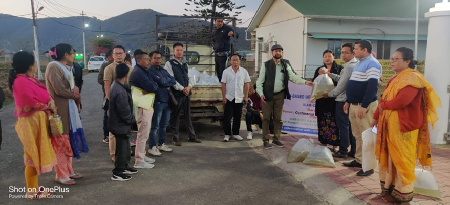
In villages such as Charoikhulen and Reangzaeng, the impact extended from livelihoods to nutrition. Increased local fish availability transformed fish from an occasional purchase into a more regular household food source. Pond-side availability reduced dependence on frozen fish transported from distant markets while improving access to fresh animal protein at an estimated 15–20% lower cost than prevailing open-market retail prices.
The experience of Churachandpur demonstrates that scientific aquaculture can do far more than raise fish—it can raise incomes, strengthen local enterprises, improve nutrition and build confidence among farming communities. By putting farmers at the centre of experimentation, monitoring and decision-making, the collaborative initiative of ICAR-CIFE, ICAR-ATARI Zone VII and ICAR-KVK Churachandpur helped transform tribal fish farmers from passive recipients of technology into informed and capable aquaculture entrepreneurs.
From acidic backyard ponds yielding modest returns to scientifically managed integrated systems generating substantially higher production and incomes, the initiative has shown that the hills of Manipur hold immense potential for a sustainable and economically rewarding blue revolution.
Its participatory model offers a promising pathway for wider adaptation across suitable tribal and hill watersheds of Manipur and the North Eastern Hill region.


फेसबुक पर लाइक करें
यूट्यूब पर सदस्यता लें
X पर फॉलो करना X
इंस्टाग्राम पर लाइक करें