


21 October 2026, Kochi
The Vizhinja Regional Centre of ICAR–Central Marine Fisheries Research Institute, Kochi launched a scientifically designed open-sea mussel longline farming unit at Vizhinjam, Kerala, marking a significant step towards promoting sustainable shellfish aquaculture and strengthening coastal livelihoods in India.
The initiative is part of the Pradhan Mantri Matsya Sampada Yojana (PMMSY)-funded project, “Development of Pilot-Scale Open-Sea Eco-Mussel Farms in India – A Blue Growth Project.” The farming unit was formally launched by Dr Shashi Tharoor, Member of Parliament from Thiruvananthapuram, today in the presence of ICAR-CMFRI scientists, representatives of the Vizhinjam Mungal Thozhilali Kshema Sangom and members of the local fishing community.
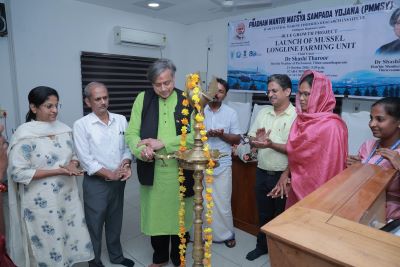
The newly established farming system comprises 20 high-density polyethylene (HDPE) floats, each with a capacity of 300 litres, arranged approximately three metres apart to support two parallel mainlines. The unit is designed to accommodate 120 vertical mussel-growing ropes, each three metres long, providing around 360 metres of productive cultivation length. Based on an estimated yield of 8–12 kg per metre of cultivation rope, the unit has the potential to produce approximately 3–4 tonnes of mussels per crop, depending on survival rates, growth conditions and farm management practices.
The demonstration farm aims to assess the technical and economic feasibility of open-sea mussel farming under Kerala’s coastal conditions and explore its potential for expansion as a sustainable mariculture enterprise.
A major achievement under the project is the establishment of a multi-species shellfish hatchery at Vizhinjam, capable of producing millions of mussel, oyster and clam seed. The facility is expected to address a major constraint in shellfish aquaculture—the dependence on seasonally available wild seed—and facilitate a more reliable supply of quality seed for large-scale farming. Dr Shashi Tharoor also visited the hatchery and interacted with scientists on advances in shellfish breeding, seed production and farming technologies.
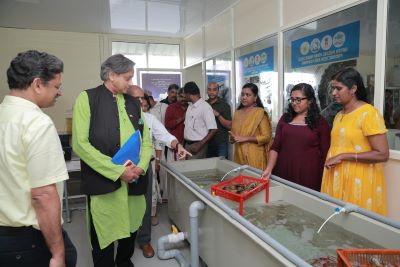
The initiative is being implemented in collaboration with the Vizhinjam Mungal Thozhilali Kshema Sangom, integrating the traditional knowledge and experience of local mussel harvesters with modern scientific farming methods. The partnership is expected to encourage community participation and create new opportunities for sustainable aquaculture-based livelihoods.
With growing domestic demand, increasing consumer interest in mussel-based cuisine and emerging export opportunities, scientifically managed mussel farming holds considerable potential for generating employment, diversifying the income of coastal communities and strengthening India’s Blue Economy.
(Source: ICAR–Central Marine Fisheries Research Institute, Kochi)


फेसबुक पर लाइक करें
यूट्यूब पर सदस्यता लें
X पर फॉलो करना X
इंस्टाग्राम पर लाइक करें