

19 June 2026, Motihari, Bihar
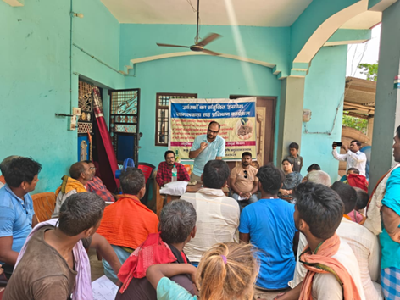
As part of the nationwide Khet Bachao Abhiyan–2026, ICAR–Mahatma Gandhi Integrated Farming Research Institute, Motihari, in collaboration with the Department of Agriculture, Government of Bihar, organized a Farmer Training-cum-Kisan Gosthi at Banjaria Block of East Champaran district, Bihar. The programme focused on promoting balanced fertilizer use, soil health restoration, green manuring, crop diversification, and climate-resilient farming practices.
Addressing the gathering, experts highlighted the objectives of the Khet Bachao Abhiyan and emphasized the importance of biofertilizers, biopesticides, organic manures, and integrated farming system approaches for restoring soil health and reducing excessive dependence on agrochemicals. They stressed that healthy food originates from healthy soils and encouraged farmers to adopt sustainable agricultural practices for long-term productivity, profitability, and environmental sustainability.
During the technical session, experts explained the role of green manuring in improving soil organic matter, enhancing microbial activity, and reducing fertilizer requirements. Farmers were encouraged to cultivate Sesbania (Dhaincha) before rice transplantation and incorporate the biomass into the soil to improve nutrient availability and soil fertility.
It was highlighted that a well-grown Dhaincha crop can contribute approximately 50–60 kg nitrogen ha⁻¹, equivalent to nearly 110–130 kg urea ha⁻¹ (about 2.5–3 bags of urea). Green manuring was described as a practice that not only supplies nutrients but also improves soil structure, water-holding capacity, biological activity, and nutrient-use efficiency in succeeding crops.
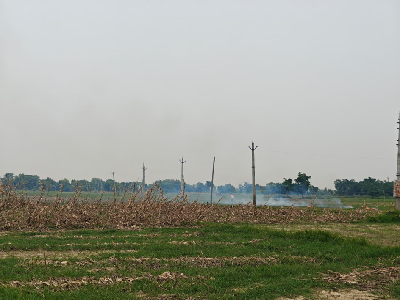
To explain the importance of soil organic matter, a simple analogy was used. Farmers were asked whether a healthy crop could grow well if a brick made from fertile topsoil was crushed and used as a growing medium. Farmers unanimously agreed that healthy crop growth would not be possible. This example was then linked to crop residue burning, with the explanation that burning crop residues destroys valuable organic carbon and nutrients essential for soil health. Just as removing fertile topsoil weakens the soil, residue burning gradually reduces soil fertility, microbial activity, and long-term productivity.
Experts also emphasized the importance of crop diversification and balanced nutrient management in addressing climate-related challenges and improving farm resilience. Farmers were encouraged to include legumes such as green gram in their cropping systems, as these crops biologically fix nitrogen and improve soil fertility while reducing fertilizer requirements in subsequent crops.
A special session was conducted on crop planning and crop calendars for rice-based systems. Farmers were advised that rice transplanted up to 10 July can accommodate long-duration varieties (145–150 days), while transplanting during late July to early August should be matched with medium-duration varieties (125–135 days). For delayed transplanting during mid-August, short-duration varieties (90–120 days) were recommended to avoid delays in sowing succeeding rabi crops such as wheat and maize, which can result in significant yield penalties.
Experts explained that proper crop planning helps farmers maximize cropping intensity, improve resource-use efficiency, and enhance profitability while maintaining the sustainability of rice-based production systems.
The programme concluded with a strong message that soil testing, balanced fertilization, green manuring, crop diversification, and residue recycling are key pillars of healthy soils and sustainable agriculture. Farmers appreciated the practical demonstrations and scientific guidance provided under the Khet Bachao Abhiyan and expressed their willingness to adopt the recommended practices in the coming cropping season.
A total of 59 farmers, including 41 male and 18 female participants, attended the programme and actively interacted with scientists and agricultural officials on issues related to soil fertility, fertilizer management, and sustainable agriculture.
(Source: ICAR–Mahatma Gandhi Integrated Farming Research Institute, Motihari, Bihar)


फेसबुक पर लाइक करें
यूट्यूब पर सदस्यता लें
X पर फॉलो करना X
इंस्टाग्राम पर लाइक करें