


In the quiet village of Sherpur, nestled along the Shimla Bypass in Dehradun district of Uttarakhand, a remarkable story of determination, innovation and women-led rural entrepreneurship has been unfolding over the past two decades. It is the story of Vimla Devi, a 53-year-old woman who transformed traditional knowledge and locally available natural resources into a thriving handloom enterprise, creating sustainable livelihoods for herself and hundreds of rural women while preserving Uttarakhand's rich handloom heritage.
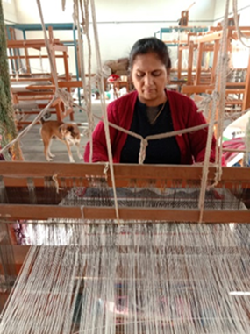
Born into a traditional farming family with limited financial resources, Vimla Devi spent her early years like countless rural women across India—managing household responsibilities while assisting in agricultural activities. Formal opportunities for employment or entrepreneurship were scarce, and the family's livelihood largely depended on farming. Yet, despite these constraints, she nurtured a strong desire to become financially independent and contribute meaningfully to her family's income.
Nearly 20 years ago, she decided to look beyond conventional farming and explore self-employment opportunities by making use of the indigenous resources available in her surroundings. What others saw as ordinary raw materials, Vimla Devi saw as an opportunity to revive traditional craftsmanship and create sustainable livelihoods.
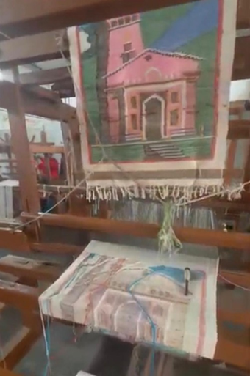
Drawing upon the abundant availability of bichchhu ghas (nettle fibre) and wool from indigenous Uttarakhand sheep, she revived the age-old practice of traditional wool spinning and weaving. The painstaking process begins with collecting raw wool, thoroughly cleaning it, and manually spinning it into fine yarn using the traditional takli (spindle). The hand-spun yarn is then woven on traditional handlooms into high-quality products that beautifully combine utility with cultural heritage.
Her enterprise today produces a diverse range of eco-friendly handcrafted products, including:
Shawls and stoles
Mufflers
Lohis (traditional blankets)
Thulma and Chutka (traditional woollen garments)
Uttarakhandi jackets
Caps
Temple-designed wall hangings depicting Kedarnathand Badrinath
These handcrafted products are appreciated for their natural texture, warmth, durability and cultural authenticity. Produced entirely through traditional methods without the use of chemicals, they are environmentally sustainable and increasingly preferred by consumers seeking eco-friendly and authentic handcrafted products.
The uniqueness of her work also earned national appreciation. During his visit to the Forest Research Institute (FRI), Dehradun, the Prime Minister Shri Narendra Modi appreciated Vimla Devi's efforts in preserving and promoting indigenous handloom traditions through sustainable use of local resources.
As her enterprise gradually expanded, Vimla Devi realised that true success lies in taking others along. She began involving women from nearby villages in various stages of production, including spinning, weaving, finishing and packaging. Today, 25 rural women are directly engaged in her enterprise, earning a regular livelihood while working close to their homes.
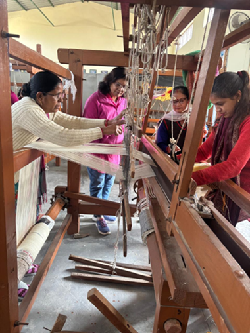
Recognising the importance of skill development, Vimla Devi also emerged as a master trainer. Over the years, she has trained more than 1,000 women in wool spinning, weaving and product development. These capacity-building initiatives have enabled rural women to generate income from home, strengthen their technical skills, improve their confidence and contribute economically to their households. The additional income has enhanced their participation in family decision-making while improving their social status within their communities.
Like many rural entrepreneurs, market access posed a major challenge during the initial years. However, through perseverance and continuous participation in state and national-level exhibitions, fairs and craft melas, she successfully established market linkages for her products. Her handcrafted products are also marketed through Tribes India, providing wider visibility, better market access and fair pricing. These platforms have helped her build a loyal customer base while exposing her to evolving market trends, consumer preferences and quality standards.
The steady growth of her enterprise is reflected in the consistent rise in her annual income. The transformation becomes even more evident when comparing her enterprise before and after institutional intervention.
Economics of the enterprise before and after KVK intervention
Main source of income before intervention: Traditional crops such as mandua, wheat, maize and vegetables.
Main source of income after intervention: Handloom enterprise.
Enterprise capacity: Expanded from leased agricultural land to 8 operational handloom units.
Total production before intervention: Approximately 1–2 quintals.
Gross annual income: Increased from ₹12,000 to ₹4,80,000.
Net annual income: Increased from ₹12,000 to ₹4,00,000.
This remarkable increase in income has significantly improved her family's quality of life by ensuring better education, healthcare and financial security. More importantly, the enterprise has generated sustainable livelihood opportunities for many associated women, contributing to poverty reduction, women empowerment and inclusive rural development.
A crucial pillar in this transformational journey has been the support of Krishi Vigyan Kendra (KVK), Dehradun. The KVK provided timely technical guidance, exposure visits and institutional linkages that strengthened her enterprise and enhanced its credibility. The convergence of traditional knowledge with scientific and institutional support enabled her to convert a small household initiative into a successful rural enterprise.
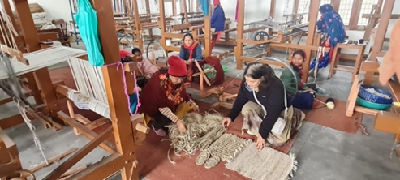
Today, Vimla Devi's story stands as a powerful example of grassroots innovation rooted in indigenous knowledge, sustainability and women-led entrepreneurship. By effectively utilizing local resources, conserving traditional handloom practices, generating sustainable livelihoods and empowering more than 1,000 rural women through skill development, she has demonstrated how rural enterprises can create lasting economic and social impact.
Her journey reminds us that transformative change does not always begin with abundant resources it begins with vision, perseverance and the courage to believe that even the simplest local resource can weave a future of dignity, opportunity and prosperity for an entire community.
(Source: G B Pant University of Agriculture & Technology, Krishi Vigyan Kendra, Dhakrani, Dehradun, Uttarakhand)


Like on Facebook
Subscribe on Youtube
Follow on X X
Like on instagram