


23-27 July 2026, Pulicat
In a significant step towards conserving India's rich aquatic biodiversity and building climate-resilient fisheries, the ICAR–Central Inland Fisheries Research Institute, Barrackpore successfully organised a series of five Field Day-cum-Community Awareness Programmes on the conservation of indigenous fish species in Pulicat Lake from 23–27 July 2026. The initiative was conducted under the institute's research project, "Assessing Shifts in Fish Diversity, Environment, and Fish Stocks in Relation to Climate Change in Pulicat Lake."
Pulicat Lake, one of India's largest brackishwater lagoons, supports a diverse assemblage of indigenous fish species and sustains the livelihoods of thousands of traditional fishing families. With growing concerns over climate change, habitat degradation and unsustainable fishing practices, the programme sought to strengthen community-led conservation efforts and promote sustainable fisheries management.
The programme was implemented under the overall guidance of Dr PradipDey, Director, ICAR-CIFRI.
The awareness sessions featured interactive discussions, field demonstrations and practical guidance on the ecological importance of indigenous fish species, sustainable fishing practices, biodiversity conservation and the impacts of climate change on the Pulicat Lake ecosystem. Participants were encouraged to adopt community-driven conservation measures to safeguard both fish diversity and the livelihoods dependent on the lake.
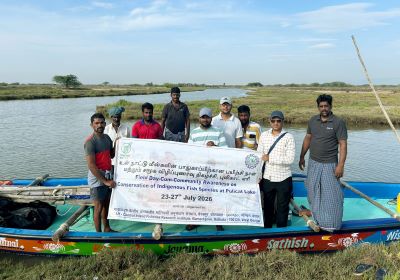
Reflecting on the initiative, Dr Dey emphasized that conservation of indigenous fish biodiversity is a strategic imperative for safeguarding aquatic ecosystem health, enhancing climate resilience, and ensuring sustainable fisheries-based livelihoods. He stressed that the long-term ecological security and productive potential of Pulicat Lake can only be achieved through an integrated management framework that promotes convergence among scientific institutions, government agencies, and local fishing communities. Highlighting the importance of evidence-based policy interventions, he advocated for participatory governance, ecosystem-based resource management, and community stewardship to ensure the sustainable conservation and utilization of the lake's fisheries resources for future generations.
More than 115 stakeholders, including ICAR-CIFRI Scientists and Technical personnel, Officials from the Department of Fisheries, representatives of fishermen's Cooperative Societies, community leaders and local fishers, actively participated in the five-day campaign. The programmes provided an effective platform for dialogue between researchers and fishing communities, fostering greater awareness and collective responsibility for conserving the lake's unique aquatic biodiversity.
The initiative reaffirms ICAR-CIFRI's commitment to science-driven fisheries management, conservation of indigenous aquatic biodiversity, and empowering local communities as key partners in protecting ecologically important inland and estuarine ecosystems for future generations.
(Source: ICAR- Central Inland Fisheries Research Institute, Barrackpore)


Like on Facebook
Subscribe on Youtube
Follow on X X
Like on instagram