


18 June 2026, Pune
As part of the ongoing Khet Bachao Abhiyan, a multidisciplinary team of scientists from the ICAR–Directorate of Floricultural Research, Pune, conducted an awareness programme today at Dhanore Village in Khed Taluka, Pune district, focusing on reviving soil health for sustainable enhancement of flower crop productivity. The programme aimed to create awareness among farmers regarding the importance of maintaining soil fertility through organic, natural, and integrated farming approaches. The event was attended by progressive farmers, local input dealers, fertilizer company representatives, and other stakeholders involved in agriculture and floriculture.
During the interactive session, scientists emphasized the critical role of healthy soil in sustaining crop productivity and improving flower quality. Farmers were educated on the use of biofertilizers, green manuring, vermicomposting, and organic farming practices for improving soil biological activity and nutrient availability. Special emphasis was given to the principles of natural farming, including the preparation and use of Beejamrit and Jeevamrit, mulching, and Waaphasa, which collectively contribute to restoring soil health while reducing dependence on chemical inputs. The scientists also highlighted the benefits of integrated farming systems in maintaining long-term soil productivity and environmental sustainability.
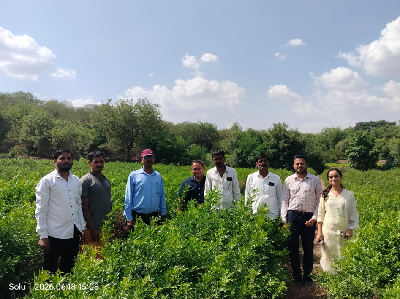
An interactive discussion was held with representatives of Tushar Agro Services, who shared observations regarding fertilizer usage patterns in the village. It was noted that some farmers were applying fertilizers and pesticide at rates exceeding the recommended doses mentioned on product labels, which may adversely affect soil health and crop performance. The dealer expressed interest in promoting biofertilizers and organic farming inputs, and the participating farmers also showed enthusiasm towards adopting these sustainable alternatives.
During the subsequent field visit, farmers expressed serious concerns regarding the quality of irrigation water sourced from the Indrayani River. The river is reportedly affected by industrial pollution and heavily infested with invasive free-floating aquatic weeds, which obstruct water flow and limit irrigation availability. These conditions, coupled with the prevailing heat-wave situation, have resulted in stunted growth and yellowing symptoms in daisy crops. The programme concluded with recommendations on balanced nutrient management, soil health restoration, and regular monitoring of irrigation water quality to enhance the sustainability and profitability of flower cultivation in the region.
A total of 15 farmers participated in the programme, cultivating crops such as aster, daisy, sunflower, gomphrena, kamini, and gypsophila.
(Source: ICAR–Directorate of Floricultural Research, Pune)


Like on Facebook
Subscribe on Youtube
Follow on X X
Like on instagram